
Lakewood Rotary has supported Little Free Pantries in Lakewood for five years. Success can be measured by how frequently the pantries have items available rather than sitting empty.
Certain pantries, such as that at Lakewood Presbyterian Church, have achieved notable success. Lakewood Presbyterian sits in a moderately well-off neighborhood. Other pantries, such as the ones in Springbrook, lack similar resources; while community members generously share items like clothing and household items, most of them are experiencing food insecurity.
The Lakewood YMCA (The Y) pantry, which began as a simple indoor collection point, has evolved into the most successful pantry operation, now functioning with substantial community backing. This may be attributable to its ratio of full-paying to discounted members, 75% are full-paying members, and 25% are on financial assistance, suggesting robust community support available for every individual on financial assistance.
Alternatively, it may be an issue of awareness. Recognizing food insecurity can be difficult, especially for those not affected by hunger and instead maybe personally focused on weight management. People who are preoccupied with weight management may not notice signs of food insecurity around them, as their attention is directed toward dietary choice.
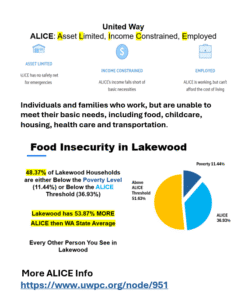 The United Way uses a specific measurement to identify individuals who are employed but still struggle to afford the basic cost of living in their communities. This group is referred to as ALICE, which stands for Asset Limited, Income Constrained, Employed.
s and health goals rather than access to food.
In Lakewood, the number of residents who fall into the ALICE category, combined with those living below the federal poverty threshold, totals 48% of the local population. This statistic highlights the significant portion of the community facing financial challenges despite being employed.
Lakewood’s ALICE rate is notably high—54% greater than the average for Washington state. This disparity underscores the particularly acute economic pressures experienced by Lakewood residents compared to the broader state population.
Given these figures, it is likely that nearly every other person encountered in Lakewood is experiencing food insecurity. The widespread nature of this issue reflects the broader challenges related to affordability and access to basic necessities within the community.
For more information and how to help see https://lakewoodrotary.com/little-free-pantry-initiative/